Should You Sell Your House Off Market?
Selling off-market may suit a Canadian homeowner who wants controlled exposure and can manage buyer inquiries. Compare likely net proceeds, time, privacy and workload against a public listing. A private sale does not guarantee a higher price or a faster closing; choose the route that fits your property and deadline.
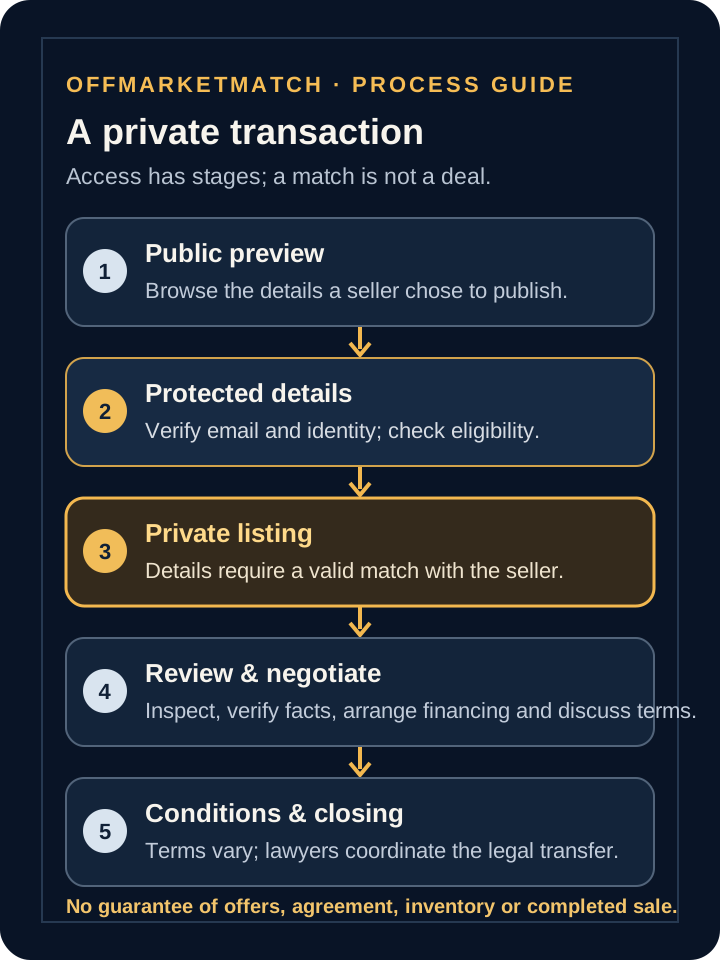
What Does 'Off-Market' Actually Mean?
An off-market home sale is simply a transaction that occurs outside of a public Multiple Listing Service (MLS). The seller and buyer connect through private channels — personal networks, private platforms, direct outreach — and complete the transaction without the property ever appearing on Realtor.ca or similar public portals. In Canada, this is entirely legal. The only professional legally required is a real estate lawyer, who handles title transfer, mortgage discharge, and closing documents. An agent is optional.
When Off-Market Selling Makes the Most Sense
Off-market is particularly well-suited for sellers who value privacy and control above maximizing exposure. If you're going through a divorce, an estate settlement, or a financial transition, the thought of strangers touring your home every weekend can be genuinely uncomfortable. High-net-worth sellers with distinctive properties often prefer private channels for the same reason — a public listing invites curiosity-seekers alongside genuine buyers.
Sellers with unique or hard-to-price properties also benefit. A heritage home, a working farm, a waterfront cottage with specific access rights — these aren't well-served by MLS's standardized format. The right buyer is a specific person, and private platforms are better at finding them.
Finally, sellers who are simply tired of the traditional process — the staging, the open houses, the weeks of uncertainty — often find that off-market lets them transact on their timeline with pre-screened buyers, closing when it works for them rather than when the market dictates.
The Financial Case
The most immediate argument for off-market is money. A typical Canadian real estate transaction involves a 4–5% commission split between buyer and seller agents. On a $700,000 home, that's $28,000–$35,000 going to intermediaries. In Toronto or Vancouver, where average home prices exceed $1M, commissions regularly top $50,000.
Private sales eliminate or dramatically reduce this cost. Even accounting for legal fees (typically $1,500–$3,000) and a proper independent appraisal, sellers retain far more equity. The counterargument — that public exposure generates higher prices — is less consistent than the industry suggests. In supply-constrained markets, off-market sellers regularly receive full-price or near-full-price offers without the cost and disruption of public listing.
When Off-Market Is NOT the Right Choice
Honesty matters here: there are situations where MLS remains the better option. If your property is in a highly competitive neighbourhood where bidding wars routinely push prices 15–20% above asking, the commission cost might be offset by the higher price the public competition generates.
If you have an unusual property in a thin market — one that needs maximum exposure to find its specific buyer — MLS's broad reach has genuine value. And if you have no network and no private platform to connect with buyers, going private without the right infrastructure puts you at a disadvantage.
Off-market isn't for everyone. It's for sellers who are informed, prepared, and committed to managing their own transaction.
How OffMarketMatch Changes the Equation
The traditional criticism of off-market selling was that you sacrificed reach for privacy. OffMarketMatch addresses this directly: a platform with thousands of verified, active buyers who have pre-submitted their criteria, verified their identity, and committed to serious engagement. You're not choosing between a private sale and exposure — you're choosing private exposure to the right buyers.
How do I compare the two routes fairly?
Compare written offers and costs, not an assumed commission saving. For a hypothetical $600,000 sale, a quoted 4% commission would equal $24,000 before tax. That is a calculation, not a standard rate. A private offer at $570,000 could still leave you worse off. Subtract your actual listing, legal, discharge and other closing costs from each offer.
What if I need a buyer immediately?
Set a review date before starting. Decide how many qualified inquiries you need, what documents buyers can receive, and when you would change the price or selling route. A private listing does not guarantee an inquiry or a closing date. If your purchase depends on selling first, have your legal adviser review those linked obligations before accepting either agreement.
What should I prepare before meeting buyers?
Prepare a property description, an honest list of known issues, and the documents you are permitted to share. Separate public marketing material from sensitive financial or identity records. Ask buyers about financing and timing without treating a platform identity check as proof of funds. Agree on a safe viewing process and keep a written record of questions and answers.
Can I switch to an agent later?
Review any existing representation or listing agreement first. Its duration, exclusivity and compensation clauses may affect your options even if you find the buyer yourself. Ask for advice before cancelling, relisting or signing another agreement. The useful comparison is between the obligations you actually have, not the idea that every private sale automatically avoids every possible brokerage payment.
Primary sources and further checks
These official references cover transaction preparation and the specific topics noted below. They are not evidence of off-market sales volume, a guaranteed saving or future property prices. Check current rules and obtain advice for your own transaction.
- Financial Consumer Agency of Canada: Buying a home
Housing costs, affordability and mortgage preparation.
- CMHC: Homebuying Step by Step
Planning, evaluating a home, making an offer and closing preparation.
Key Takeaways
- 1.Off-market selling is 100% legal in Canada — only a lawyer is required, not an agent
- 2.Commission savings of 4–5% translate to $28,000–$50,000+ on typical Canadian home prices
- 3.Off-market is ideal when privacy, control, and timeline flexibility matter more than maximum exposure
- 4.In supply-constrained markets, off-market sellers often receive full-price offers without the disruption of public listing
- 5.The right platform — one with verified buyers — eliminates the traditional trade-off between privacy and reach
Do This Week
Request a free AI-powered valuation of your property on OffMarketMatch. Understanding your market value is the first step to deciding whether off-market makes sense for your situation.
Get Started on OffMarketMatchRelated Academy Articles
Pros and Cons of Selling Your Home Without MLS
How Private Home Sales Work in Canada
What Is a Pocket Listing?
Why More Canadian Homeowners Are Selling Privately
How to Sell Your Home Without a Realtor in Canada
Ready to Put This Into Practice?
Join OffMarketMatch and access Canada's private real estate market — verified buyers, private sellers, no agent required.