Why More Canadian Homeowners Are Selling Privately
Canadian sellers may choose a private sale to control exposure, speak directly with buyers or manage a sensitive move. The trade-off is a different buyer audience and responsibility for marketing and inquiries. Privacy does not guarantee a better offer; compare net proceeds, timing and workload before choosing a selling route.
The Commission Math Has Changed
Twenty years ago, Canadian homes sold for $200,000–$400,000 in most markets. A 4–5% commission cost $8,000–$20,000 — significant, but arguably reasonable for the service provided. Today, those same homes sell for $600,000–$1.5M or more. The percentage hasn't changed. The dollar amount has tripled.
A $1M Toronto home now costs $40,000–$50,000 in agent commissions. A $800,000 Ottawa home costs $32,000–$40,000. The value proposition of paying this amount for an agent to handle paperwork and schedule showings has become increasingly difficult to justify when sellers can access private platforms with thousands of verified buyers.
Technology Has Democratized Real Estate Information
The primary historical value of a real estate agent was information access — only agents could see what similar homes had sold for, only agents could access the MLS database, only agents had the professional network to reach buyers. All of this is now available to any informed homeowner.
Sold prices are publicly available. AI valuation tools provide market-calibrated pricing estimates. Private platforms like OffMarketMatch provide direct access to verified buyer networks. The information asymmetry that justified the traditional model has largely collapsed.
The Privacy Premium
Canadian homeowners increasingly understand that an MLS listing puts detailed information about your home — and implicitly, your financial situation — on the public internet. Divorce, financial hardship, estate settlement, relocation — the context behind a sale is personal. A private platform lets sellers share the information they choose with buyers they've pre-screened, rather than broadcasting it to the world.
This privacy premium is particularly pronounced for high-net-worth sellers and those in sensitive life transitions, but it applies broadly to anyone who values control over who has access to their home and the story behind their sale.
The 'Consumer Choice' Movement
Across Canada, a genuine consumer movement is questioning the mandatory nature of agent intermediation in real estate. In most industries, consumers can choose their level of service — from full-service to DIY. Real estate has traditionally resisted this, with MLS access controlled by associations that required agent membership.
This is changing. Private platforms operate outside the MLS framework entirely. The question is no longer whether you can sell privately — it's whether you're informed enough and connected enough to do it effectively. The answer for more Canadian sellers every year is yes.
The Legal Reality: Only a Lawyer Is Required
The most important fact that more Canadians are discovering: in every province and territory, only a real estate lawyer (or notary in Quebec and BC for straightforward transactions) is legally required to transfer property ownership. Everything else — agents, MLS listings, open houses, staged photography — is optional.
Knowing this changes how you approach a sale. The question becomes not 'do I need an agent?' but 'what services do I want to pay for?' That's a much more empowering question.
How can I make privacy a practical requirement?
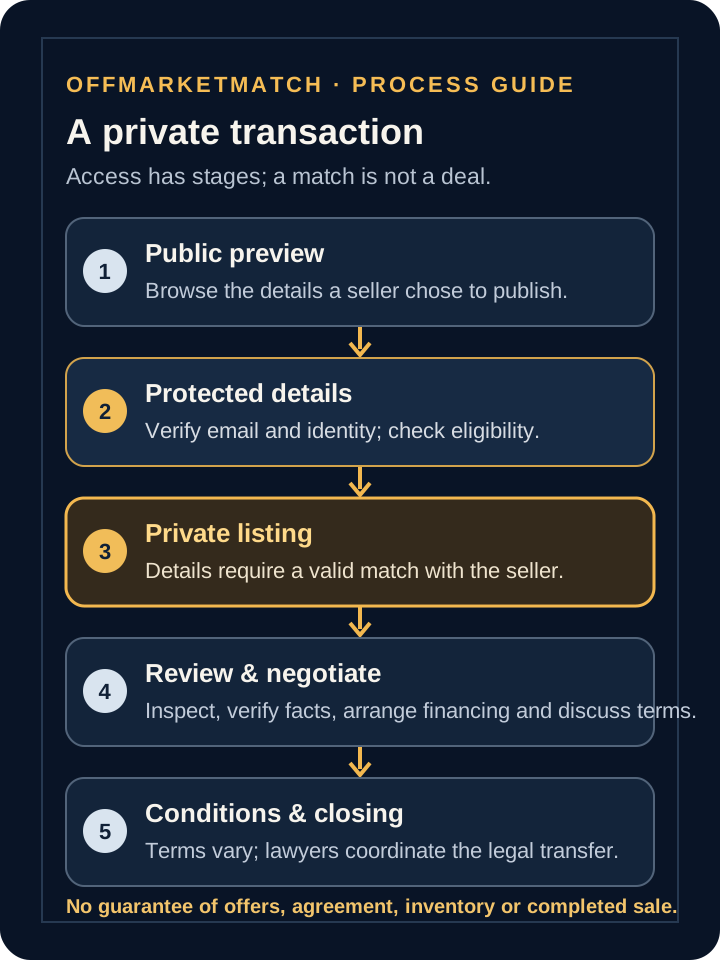
Write down the information you do not want publicly distributed, such as tenant records or personal financial documents. Then decide what can appear in a listing preview and what qualified buyers may receive later. Ask how each channel handles sharing and access. Privacy is a set of choices and controls, not a promise that nobody will ever learn the property is available.
How do I judge an offer beyond its price?
Compare financing conditions, deposit arrangements, closing date and any obligations you must complete. A higher offer with uncertain financing can differ from a lower offer with a workable timeline. Neither is automatically better. Ask your legal adviser to explain the conditions and consequences. Keep a written comparison so your decision does not depend on the most persuasive buyer conversation.
What should I do if private inquiries are slow?
Review the price, property information and likely buyer audience before changing everything at once. Ask whether interested buyers have enough information to decide. Establish a review date and a fallback selling route. Private marketing has no guaranteed inquiry rate. A documented plan lets you adjust the approach without accepting an unsuitable offer merely because you hoped for a faster result.
Does choosing a private sale remove my disclosure duties?
No. Choosing a different marketing route does not make known property issues disappear or remove contractual obligations. Ask a local legal professional what must be disclosed and how to document it. Preserve questions, answers and amendments. If a buyer asks about a defect you cannot assess, say what you know and arrange appropriate investigation rather than filling the gap with reassurance.
Primary sources and further checks
These official references cover transaction preparation and the specific topics noted below. They are not evidence of off-market sales volume, a guaranteed saving or future property prices. Check current rules and obtain advice for your own transaction.
- Financial Consumer Agency of Canada: Buying a home
Housing costs, affordability and mortgage preparation.
- CMHC: Homebuying Step by Step
Planning, evaluating a home, making an offer and closing preparation.
Key Takeaways
- 1.Rising home prices have made the dollar cost of agent commissions dramatically higher without proportional increases in service value
- 2.Technology has democratized access to market information that was previously agent-exclusive
- 3.Privacy concerns — particularly for sensitive life transitions — drive significant off-market preference
- 4.The consumer choice movement is expanding real estate options beyond the traditional agent-MLS model
- 5.Only a real estate lawyer is legally required in a Canadian property transaction — everything else is optional
Do This Week
Calculate exactly what you'd pay in commissions on your home at current market value. Then look up what a real estate lawyer charges in your area for a sale transaction. The gap between those two numbers is your starting point for evaluating private sale options.
Get Started on OffMarketMatchRelated Academy Articles
Should You Sell Your House Off Market?
How Private Home Sales Work in Canada
Off-Market vs. MLS: Which Is Right for Your Real Estate Transaction?
Pros and Cons of Selling Your Home Without MLS
What Is a Pocket Listing?
Ready to Put This Into Practice?
Join OffMarketMatch and access Canada's private real estate market — verified buyers, private sellers, no agent required.