How Private Home Sales Work in Canada
A private home sale in Canada starts with a seller finding a buyer outside public MLS marketing. The parties assess the property, negotiate a written offer and address its conditions before closing. Financing, disclosure, title and provincial requirements still matter; private marketing does not replace independent legal advice.
Step 1: Determine Your Market Value
Before you can price your home correctly, you need an objective valuation. You have two solid options: an independent appraisal from a Canadian Residential Appraiser (CRA) or Accredited Appraiser Canadian Institute (AACI) designation — typically $350–$500 — or an AI-powered Comparative Market Analysis (CMA) tool that analyzes recent comparable sales in your area.
Avoid pricing based solely on what your neighbour sold for or what Zolo shows as an estimate. Your property has specific characteristics — condition, lot, finishes, suite potential — that require proper analysis.
Step 2: Prepare Your Property
A private sale doesn't mean a lazy sale. First impressions matter to every buyer, regardless of channel. At minimum: declutter every room, deep clean, make any deferred maintenance repairs that would become conditions of a buyer's offer, and photograph professionally.
For higher-value homes, consider a virtual staging service or a home stager for the initial photography session. OffMarketMatch's platform includes AI-powered virtual staging that can transform photos of empty rooms into furnished, appealing spaces — helping your listing compete with anything on MLS.
Step 3: Create Your Listing and Find Buyers
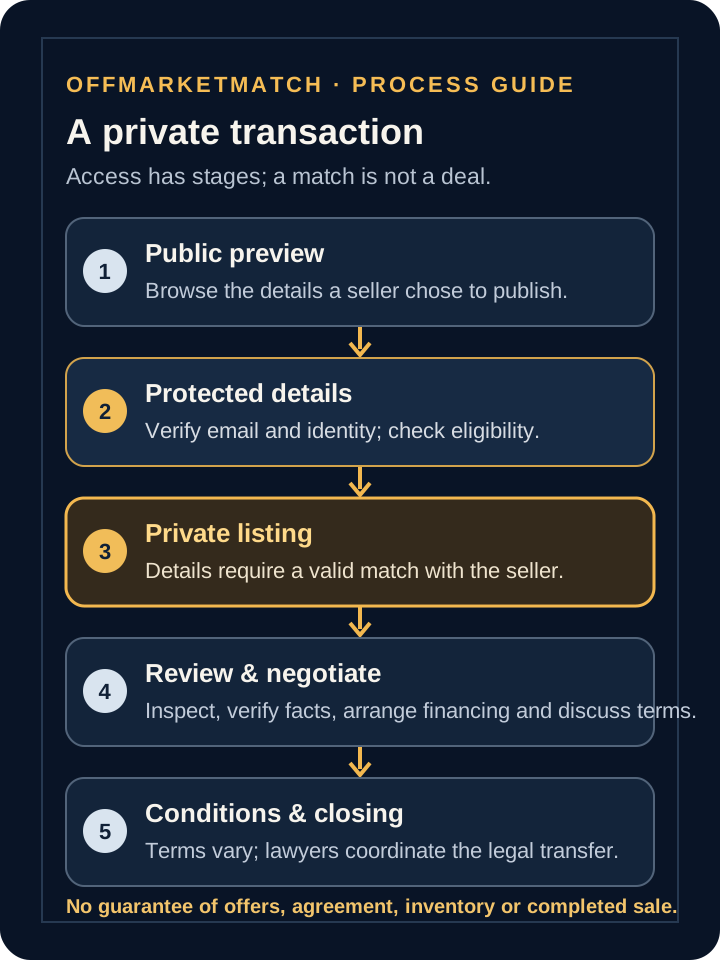
On OffMarketMatch, you create a private listing that's only visible to verified, matched buyers — not the general public. Your listing includes a description, photos, price, and key property details. The platform's AI matching engine identifies buyers whose criteria align with your property and notifies them of the opportunity.
Buyers who express interest go through an NCNDA (Non-Circumvention, Non-Disclosure Agreement) process before your personal contact information is shared. This protects your privacy throughout the discovery process.
Step 4: Screen Buyers and Arrange Showings
You control who sees your home and when. Review buyer profiles — verified identity, stated criteria, financing status — before agreeing to a showing. You can request proof of funds or mortgage pre-approval before scheduling.
Showings are arranged directly between you and the buyer (or their representative). There's no agent acting as an intermediary gatekeeper, and there are no scheduled open houses unless you choose to hold them.
Step 5: Negotiate and Accept an Offer
Buyers typically submit an Agreement of Purchase and Sale (APS) — a standard legal form used across Canada for real estate transactions. Your real estate lawyer should review any offer before you sign.
Negotiation happens directly between you and the buyer, or through your respective legal representatives. Common conditions include financing approval, home inspection, and lawyer review. Unlike MLS transactions, the timeline for conditions is entirely negotiable — you and the buyer set it based on your mutual needs.
Step 6: Fulfill Conditions and Close
During the conditional period (typically 5–10 business days), the buyer arranges their financing confirmation and home inspection. If conditions are waived, the deal is firm. Your lawyer and the buyer's lawyer then handle the closing mechanics: title search, mortgage discharge preparation, statement of adjustments, and title transfer registration.
Closing day transfers title to the buyer and net proceeds to you. The entire process from accepted offer to closing typically takes 30–90 days, depending on what both parties agree to.
What Does It Actually Cost?
The cost of a private sale is dramatically lower than a traditional agent-assisted transaction. Expect to pay: independent appraisal ($350–$500), real estate lawyer fees ($1,500–$3,000 depending on complexity), and any platform fees. Compare this to a 4–5% commission on a $700,000 home — $28,000–$35,000 — and the savings are substantial.
You may also choose to offer a buyer's agent commission to incentivize agents who bring buyers, though this is optional and negotiable in a private sale context.
What happens between an accepted offer and closing?
Acceptance starts the agreed contractual process; it does not itself transfer ownership. The parties must satisfy or address any conditions, arrange financing, provide required documents and complete the legal closing. Write down the deadlines from the agreement. Your lawyer or other authorized closing professional should explain what must happen before funds and title can be transferred.
Where should the deposit go?
Follow the deposit instructions in the agreement after your legal adviser has checked them. Confirm the recipient and payment details through an independently verified channel. Do not treat a chat message or emailed bank instruction as sufficient verification. Ask who holds the money, when it is due, and what the agreement says about release if the transaction does not close.
What if an inspection reveals a problem?
Read the inspection condition and its deadline before deciding what to do. Depending on the agreement, the parties may discuss repairs, a price adjustment, further investigation or ending the transaction. Those options are not automatic. Keep the report and proposed changes in writing. Have any amendment reviewed and signed rather than relying on an informal promise in a conversation.
Who checks that the closing instructions are genuine?
Use the legal professional's established contact details to verify unexpected instructions. Do not send funds to a new account just because an email looks familiar. Agree on how the parties will communicate document changes and payment information. Platform messages can preserve the discussion, but they do not replace independent checks on identity, ownership, banking details or the authority to sign.
Primary sources and further checks
These official references cover transaction preparation and the specific topics noted below. They are not evidence of off-market sales volume, a guaranteed saving or future property prices. Check current rules and obtain advice for your own transaction.
- Financial Consumer Agency of Canada: Buying a home
Housing costs, affordability and mortgage preparation.
- CMHC: Homebuying Step by Step
Planning, evaluating a home, making an offer and closing preparation.
Key Takeaways
- 1.Private sales follow the same legal framework as MLS sales — only a lawyer is required, not an agent
- 2.The process: valuation → listing → buyer matching → showing → negotiation → conditional period → closing
- 3.You control who sees your home and when — no open houses unless you choose them
- 4.Total seller costs for a private sale are typically $2,000–$4,000 versus $28,000–$50,000+ in agent commissions
- 5.Closing timelines are fully negotiable — you're not bound by MLS listing window rhythms
Do This Week
Review a standard Agreement of Purchase and Sale form for your province (available from your provincial real estate association website or your lawyer). Familiarity with the document will make you a more confident negotiator.
Get Started on OffMarketMatchRelated Academy Articles
Should You Sell Your House Off Market?
Pros and Cons of Selling Your Home Without MLS
Are Off-Market Real Estate Deals Legal in Canada?
What Is a Pocket Listing?
Why More Canadian Homeowners Are Selling Privately
Ready to Put This Into Practice?
Join OffMarketMatch and access Canada's private real estate market — verified buyers, private sellers, no agent required.