How to Sell Your Home Without a Realtor in Canada
To sell a Canadian home without a listing agent, prepare property information, set a supported asking price, find buyers and negotiate a written agreement. Arrange independent legal advice for the contract and closing. Check existing representation obligations and local requirements; avoiding a listing agent does not remove every transaction cost.
How do I prepare my home for a private sale?
Prepare a price range, accurate property information and the documents your legal adviser asks for. The single most important thing to understand before selling privately: in Canada, only a real estate lawyer (or notary in Quebec) is legally required to transfer property ownership. An agent is optional. Your lawyer handles title search, mortgage discharge, transfer documentation, and closing. Your agent — if you use one — handles marketing, showings, offer management, and negotiation coaching.
When you sell privately, you handle marketing and showings yourself, and a platform like OffMarketMatch handles the buyer matching and documentation. Your lawyer still does everything legal at closing. Budget $1,500–$3,000 for lawyer fees.
Step 2: Price Your Property Accurately
Accurate pricing is the single most important factor in a successful private sale. Too high and buyers won't engage seriously; too low and you leave money on the table without the bidding dynamic of a public listing to push the price up.
Use OffMarketMatch's AI CMA tool to generate a Comparable Market Analysis based on recent sold data in your area. This gives you a data-backed price range with a confidence band. Also look at active public listings in your area for context — what are comparable homes asking? What condition are they in versus yours?
Pricing 2–3% below your target price can generate strong buyer interest that supports negotiating up to your actual target. Pricing at your ceiling and waiting rarely works in a private context.
Step 3: Prepare Your Property
In a private sale, your property often gets viewed by a smaller number of pre-qualified buyers — which means each viewing matters more. First impressions and condition set buyer confidence and affect willingness to pay.
Minimum preparation: declutter, deep clean, address obvious deferred maintenance (leaky faucets, damaged drywall, broken fixtures). Consider professional photography — OffMarketMatch's virtual staging tool can digitally furnish empty rooms. A pre-listing home inspection ($400–$600) gives you a candid assessment of what a buyer's inspector will find and lets you address issues proactively or price accordingly.
Step 4: List on OffMarketMatch and Set Your Privacy Preferences
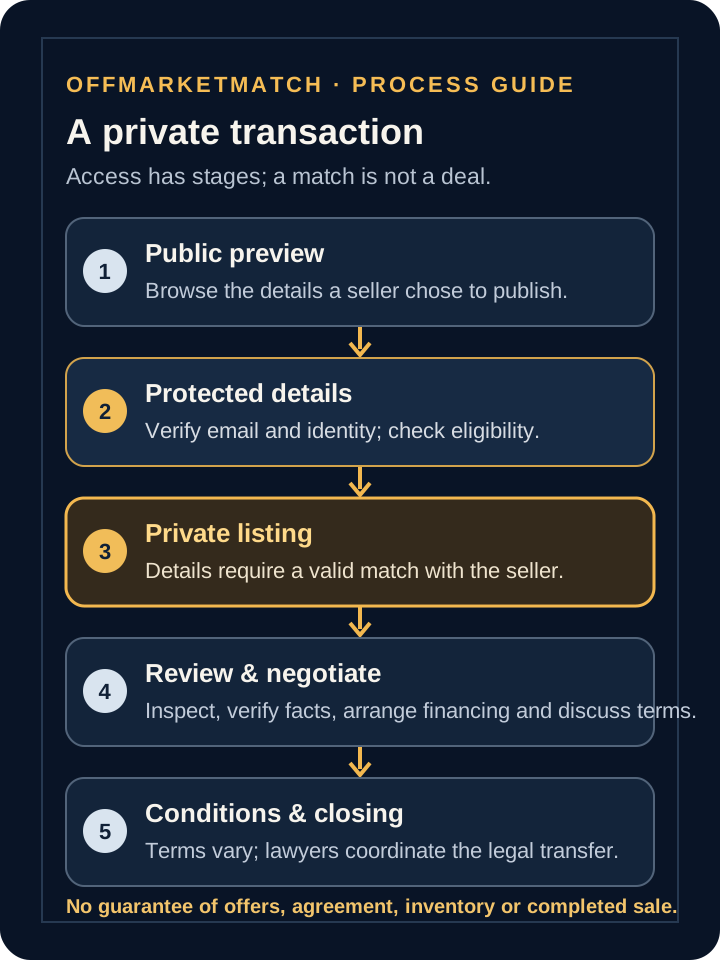
When you list on OffMarketMatch, you control what information buyers see and when. The platform automatically generates an NCNDA (Non-Circumvention, Non-Disclosure Agreement) that buyers must sign before receiving your full property details, address, and contact information.
Set your preference for who can request a showing: verified buyers only, pre-approved buyers only, or all registered users. The Deal Hunter AI system will actively match your listing against buyer Search Profiles and send notifications to qualified matches. You don't have to find buyers — the platform does it.
Step 5: Manage Inquiries and Showings
Private sales require you to handle inquiries and showings, but the pool is smaller and more qualified than a public listing with 50 open-house visitors. Expect 3–10 serious inquiries on a well-priced property before receiving an offer.
When scheduling showings, always confirm buyers have financing pre-approval before showing. The AI Negotiator on OffMarketMatch can help you prepare for common buyer questions and negotiate confidently. Keep notes on each showing: buyer's reaction, their stated concerns, and their financing status. This information informs your negotiation strategy when offers come in.
Step 6: Receive and Negotiate Offers
In a private sale, offers come to you directly through the platform's Deal Room. You can review, counter, accept, or reject offers with a complete audit trail. The Agreement of Purchase and Sale used on OffMarketMatch is a standard Canadian real estate contract — the same document used in agent-mediated transactions.
Key offer components to evaluate: purchase price, deposit amount (typically 5% of purchase price), conditional periods (financing and inspection are standard — 5 business days each is reasonable), and closing date. Use OffMarketMatch's AI Negotiator to stress-test your position before countering. A real estate lawyer is available for advice on offer terms at any stage — they typically charge $200–$400 per hour for consultation.
Step 7: The Conditional Period and Going Firm
Once an offer is accepted (conditional), the buyer typically has 5–10 business days to confirm financing and complete their home inspection. During this period, the deal is conditionally accepted — the property is effectively off the market, but either party can walk away if conditions aren't met.
If the buyer's inspection reveals issues, they may request repairs or a price reduction. This is negotiable. Common outcomes: seller agrees to reduce price by repair estimate, seller makes specific repairs, parties agree to proceeds as-is. Once both parties waive conditions, the deal is firm. You cannot accept other offers after going firm.
Step 8: Closing Day
Once conditions are waived and the deal is firm, your lawyer takes over. Approximately 5 business days before closing, you'll receive a Statement of Adjustments showing the final numbers: purchase price, deposit already paid, property tax adjustments, mortgage discharge amount, and net proceeds to you.
On closing day, your lawyer registers the title transfer with the provincial land registry and releases the net sale proceeds to you. You provide the buyer with keys. The entire process — from accepted conditional offer to possession — typically takes 30–90 days, depending on what you and the buyer agreed to.
Announce the sale to your mortgage lender in advance — they need time to prepare the discharge documentation. In most cases, your lawyer handles this communication automatically.
Primary sources and further checks
These official references cover transaction preparation and the specific topics noted below. They are not evidence of off-market sales volume, a guaranteed saving or future property prices. Check current rules and obtain advice for your own transaction.
- Financial Consumer Agency of Canada: Buying a home
Housing costs, affordability and mortgage preparation.
- CMHC: Homebuying Step by Step
Planning, evaluating a home, making an offer and closing preparation.
Key Takeaways
- 1.Only a lawyer is legally required to sell your home in Canada — agents are optional
- 2.Accurate pricing using AI CMA data is the most important factor in a successful private sale
- 3.OffMarketMatch handles buyer matching and NCNDA documentation automatically
- 4.Budget $1,500–$3,000 for lawyer fees at closing — your primary transaction cost
- 5.The Agreement of Purchase and Sale in a private transaction is the same legal contract used in agent-mediated deals
Do This Week
Run an AI CMA on your property to get a data-backed price range. Even if you're not selling yet, knowing your current market value gives you the foundation for any transaction decision.
Get Started on OffMarketMatchRelated Academy Articles
Should You Sell Your House Off Market?
How Private Home Sales Work in Canada
Pros and Cons of Selling Your Home Without MLS
What Is a Pocket Listing?
Why More Canadian Homeowners Are Selling Privately
Ready to Put This Into Practice?
Join OffMarketMatch and access Canada's private real estate market — verified buyers, private sellers, no agent required.