Off-Market Real Estate in Ontario: A Complete Guide for Buyers and Sellers
Off-market real estate in Ontario is property marketed privately rather than through a public MLS listing. Owners and buyers can explore direct transactions, but must assess disclosure, financing, title, taxes and existing agreements. Obtain local legal advice before signing; private marketing alone does not establish a saving, clean title or closing readiness.
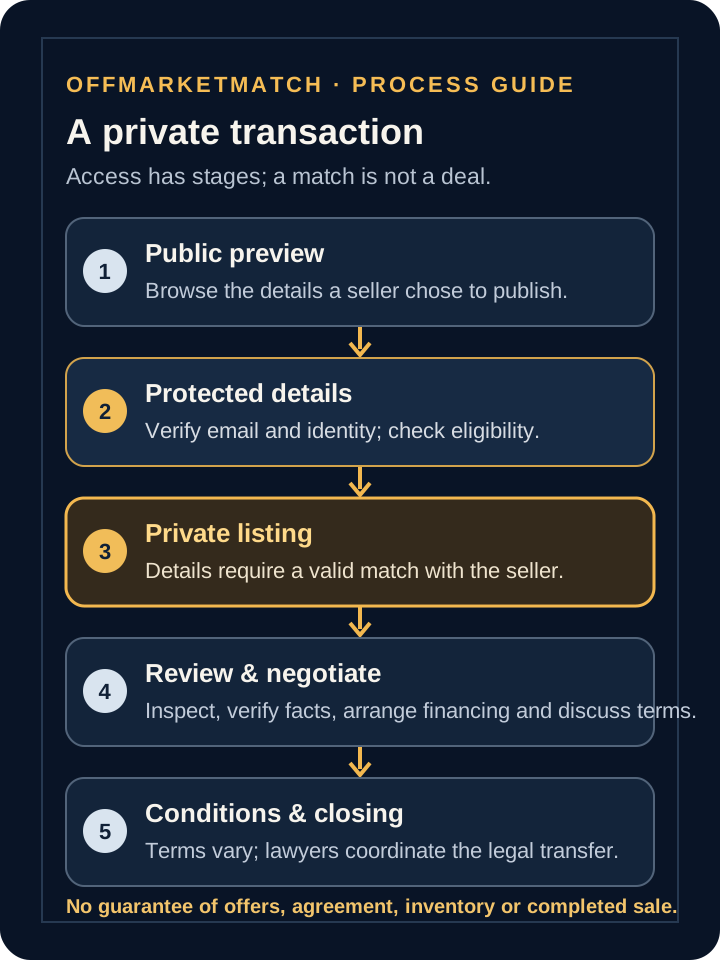
Ontario's Legal Framework for Private Sales
In Ontario, real estate transactions are governed by the Real Estate and Business Brokers Act (REBBA 2002). REBBA regulates what licensed agents must do when they're involved in a transaction — it does not require agents to be involved. Private sales in Ontario are fully legal and require only: an Agreement of Purchase and Sale (the standard Ontario form works perfectly), a real estate lawyer to handle title transfer and closing, and standard disclosure obligations to the buyer.
Ontario's disclosure requirements are relatively straightforward compared to some other provinces: sellers must disclose known material latent defects (hidden issues that would affect a buyer's decision). Failure to disclose creates legal liability — independent of whether the sale was private or agent-mediated.
The Land Transfer Tax Advantage
Ontario charges a provincial Land Transfer Tax on all property purchases. Toronto buyers pay an additional Municipal Land Transfer Tax on top. On a $900,000 Ontario purchase, the provincial LTT is approximately $16,475. On a $1M Toronto purchase, combined provincial and municipal LTT reaches approximately $32,200.
Off-market commission savings (typically $36,000–$45,000 on a $900,000 home) effectively offset the Land Transfer Tax burden entirely — making the total acquisition cost in an off-market transaction lower than a comparable MLS deal even after accounting for taxes.
Ontario's Most Active Off-Market Cities
The GTA dominates Ontario's off-market volume: Toronto (luxury, condos, investment multifamily), Mississauga (established luxury neighbourhoods, condo assignments), Hamilton (investor market, century homes), Ottawa (government employee motivated sellers, diplomatic community), Kitchener-Waterloo (tech worker market), and the '905 belt' communities.
Smaller Ontario cities with active off-market segments include Kingston (student rentals, military, heritage), London (student rentals, Western University corridor), Belleville (CFB Trenton motivated sellers, Bay of Quinte waterfront), and Peterborough (Toronto overflow buyers, Trent-Severn waterfront).
Who Is Selling Off-Market in Ontario?
Estate sales and executor-managed properties are among the most common private transactions — executors want speed, discretion, and minimal carrying costs. Landlords exiting rent-controlled Ontario properties frequently sell privately to avoid disruption to tenants and the scrutiny of a public listing showing a below-market tenant. High-net-worth sellers in premium neighbourhoods choose privacy over incremental bidding competition. Builders and developers transacting land parcels and commercial properties almost always go private.
Ontario-Specific Due Diligence
Ontario buyers in private transactions should conduct: title search through the land registry (your lawyer handles this), Tarion warranty verification for newer properties, zoning and permitted use confirmation with the municipality, property tax verification, and — for condo purchases — status certificate review.
For income properties: obtain current leases, review tenants' rent histories, and understand Ontario's Residential Tenancies Act obligations. Ontario has strong tenant protections — buyers assuming tenancy relationships need to understand what they're taking on.
What should Ontario buyers budget beyond the price?
Ask your closing professional for an itemized estimate covering taxes, legal work, adjustments and other applicable costs. A Toronto property can have different tax considerations from a property elsewhere in Ontario. Eligibility for rebates or exemptions depends on the buyer and transaction. Private marketing does not remove those obligations. Use current official guidance and your own circumstances rather than a generic provincial estimate.
What if the property has tenants?
Request the leases, rent roll and other appropriately shared records. Clarify what the agreement says about possession and existing tenancies. Do not assume buying privately permits immediate vacancy or a rent increase. Obtain Ontario-specific advice before relying on a change of occupancy. Your financing and investment plan should distinguish current documented income from a future scenario that may not be available.
How do I compare Ontario private listings?
Compare location, condition, property type and the evidence supporting price. Separate an active seller-submitted listing from a discussion about a potential sale. Ask what information is still missing and set a limit on investigation spending. A hypothetical $30,000 renovation allowance should be supported by a scope and quotes before becoming a firm budget. Off-market access does not establish a discount.
What if a seller already has an agent?
Ask about the existing agreement and any limits on private negotiation. Representation and compensation obligations require their own review. A direct conversation through a platform does not automatically cancel a brokerage contract. Have the relevant terms checked before signing an offer or promising that no fee will arise. Keep the property information and agreed changes consistent across any permitted marketing channels.
Primary sources and further checks
These official references cover transaction preparation and the specific topics noted below. They are not evidence of off-market sales volume, a guaranteed saving or future property prices. Check current rules and obtain advice for your own transaction.
- Financial Consumer Agency of Canada: Buying a home
Housing costs, affordability and mortgage preparation.
- CMHC: Homebuying Step by Step
Planning, evaluating a home, making an offer and closing preparation.
- Ontario: Register your land documents
Ontario electronic land registration and authorized registration services.
Key Takeaways
- 1.Ontario private sales are governed by REBBA 2002 — agents are regulated but not required
- 2.Off-market commission savings on a $900K Ontario home effectively offset the provincial Land Transfer Tax
- 3.The GTA, Hamilton, Ottawa, and several mid-size cities have highly active off-market segments
- 4.Estate sales, rent-controlled landlord exits, and luxury sellers drive the majority of Ontario's private market
- 5.Ontario income property buyers must review leases and understand RTA obligations before purchasing
Do This Week
If you're an Ontario buyer, set up a Buy Box on OffMarketMatch for your target market and price range. If you're a seller, run an AI CMA to get your current market value — your starting point for a private pricing strategy.
Get Started on OffMarketMatchRelated Academy Articles
The Complete Guide to Off-Market Real Estate in Canada
How to Sell Your Home Without a Realtor in Canada
Are Off-Market Real Estate Deals Legal in Canada?
How Real Estate Investors Find Off-Market Deals in Canada
How to Buy Property Before It Hits MLS in Canada
Ready to Put This Into Practice?
Join OffMarketMatch and access Canada's private real estate market — verified buyers, private sellers, no agent required.