The Complete Guide to Off-Market Real Estate in Canada
Off-market real estate in Canada is property marketed through channels outside public MLS listings. Buyers still need to assess ownership, condition, price and financing; sellers still need accurate information and a workable marketing plan. A written agreement, appropriate conditions and independent legal closing remain important regardless of how the parties meet.
What Is Off-Market Real Estate?
Off-market real estate refers to properties that are transacted privately — without a public MLS listing, without public open houses, and typically without broad public advertising. The transaction happens between a seller and a verified buyer through a private network, platform, or personal connection.
Off-market is sometimes called 'private real estate,' 'pocket listings,' or 'private sales.' The terminology varies but the concept is consistent: the property and its terms are visible only to qualified, pre-screened parties rather than the general public.
Is Off-Market Real Estate Legal in Canada?
Completely and unambiguously yes. In Canada, the only legally required professional in a real estate transaction is a lawyer (or notary in Quebec) who handles title transfer at closing. There is no law requiring a seller to list on MLS, to use a licensed agent, or to publicly advertise a property.
Off-market transactions have been happening in Canada for as long as real estate has been bought and sold. Platforms like OffMarketMatch simply provide organized infrastructure for what was previously done informally.
How Much of the Canadian Market Is Off-Market?
Reliable data is difficult to collect by definition — private transactions don't appear in MLS statistics. Industry estimates consistently put private transaction volume at 20–30% of total residential transactions, with significantly higher rates in certain segments: luxury properties above $2M, income and investment properties, estate settlements, and commercial real estate.
In some specialized markets — assignment sales, development land, luxury in major cities — the off-market channel is the primary market.
Why Do Sellers Choose Off-Market?
Privacy is the most common reason — many sellers don't want strangers touring their home, their financial situation broadcast publicly, or their asking price permanently on record. Control is the second reason — private sellers determine who sees the property, when, and under what conditions.
Financially, avoiding agent commissions saves 4–5% of sale price. On a $700,000 home, that's $28,000–$35,000. On a $1.5M home, over $60,000. Estate situations, divorce, and landlord exits from rental properties add practical reasons: speed, discretion, and avoiding the disruption of public listing to tenants or family members.
Why Do Buyers Choose Off-Market?
Access is the primary driver for buyers. Off-market properties represent real estate that will never appear on Realtor.ca — the only way to find them is through private channels. For investors, this means accessing motivated sellers before competition drives prices up. For end users, it means finding properties that match specific criteria without competing in public bidding environments.
In competitive markets like Toronto and Vancouver, where good MLS listings attract multiple offers within days, off-market access gives buyers a chance to negotiate thoughtfully rather than compete reactively.
The Off-Market Transaction Process
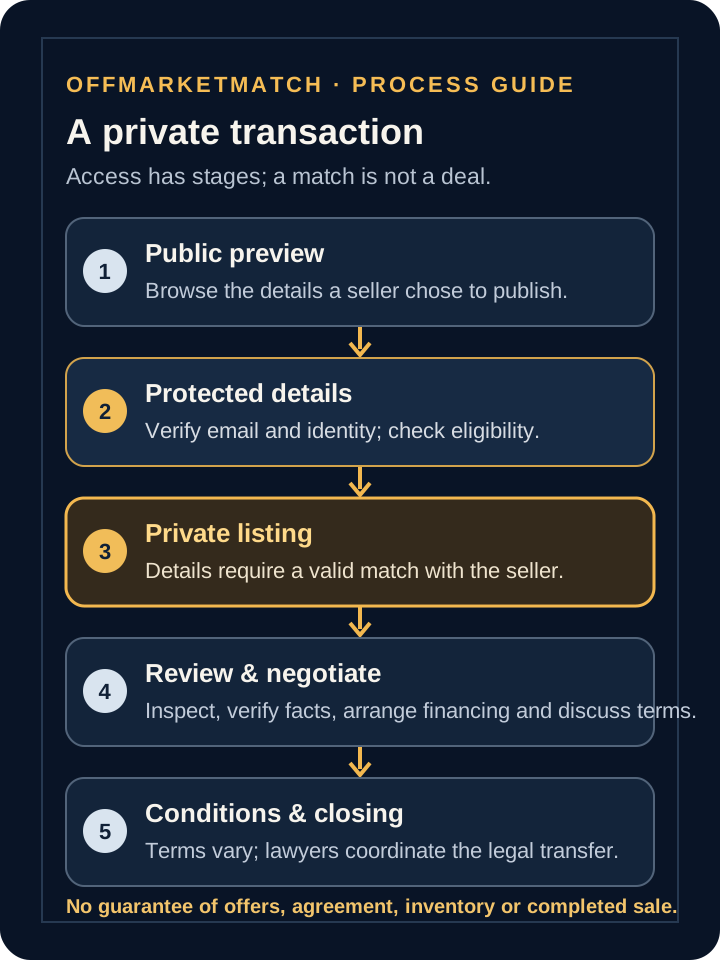
A private transaction needs discovery, independent assessment, an agreement and legal closing. The sequence below is illustrative: required agreements, conditions and access depend on the listing and the parties' circumstances.
- Seller prepares an accurate listing, privacy settings and asking price.
- Buyer sets Search Profile criteria for location, property type, budget and strategy.
- Buyer reviews available opportunities; a match is not a confirmed deal.
- Buyer checks access eligibility and requests a seller conversation.
- Parties complete any required agreements before sharing protected information.
- Seller considers financing evidence separately from platform identity verification.
- Parties arrange a viewing and appropriate property checks.
- Buyer submits an offer through the available deal process.
- Parties negotiate and keep a written record of agreed changes.
- Parties obtain advice on the agreement and appropriate conditions.
- Parties address conditions and their contractual deadlines.
- Legal professionals arrange title work, funds and closing.
- Parties exchange possession according to the agreement.
Key Documents in a Private Sale
NCNDA (Non-Circumvention, Non-Disclosure Agreement): Protects seller privacy — buyer agrees not to share property information or attempt to bypass the platform to transact directly. Agreement of Purchase and Sale: The standard Canadian real estate contract — legally identical to the one used in agent-mediated transactions. Includes price, deposit, conditions, and closing date. Condition Removal: Written waiver of conditions (financing, inspection) that makes the deal firm. Transfer Deed: Prepared by lawyers and registered with the provincial land registry on closing day.
Off-Market for Investors
Investors are the most active participant segment in Canadian off-market real estate. The reasons are clear: motivated sellers (landlords exiting rent-controlled positions, estate executors, developers needing capital), properties that don't fit the conventional presentation expected by retail buyers (tenant-occupied, deferred maintenance, development potential), and the ability to negotiate based on fundamentals rather than emotion.
Off-market investors use Search Profiles — defined criteria for property type, location, price, and return targets — to efficiently filter opportunities. OffMarketMatch's Deal Hunter AI automates this process, scanning new listings against investor criteria and delivering curated matches.
Primary sources and further checks
These official references cover transaction preparation and the specific topics noted below. They are not evidence of off-market sales volume, a guaranteed saving or future property prices. Check current rules and obtain advice for your own transaction.
- Financial Consumer Agency of Canada: Buying a home
Housing costs, affordability and mortgage preparation.
- CMHC: Homebuying Step by Step
Planning, evaluating a home, making an offer and closing preparation.
Key Takeaways
- 1.Off-market real estate is completely legal in all 13 Canadian provinces and territories
- 2.An estimated 20–30% of Canadian residential transactions happen outside public MLS channels
- 3.Sellers save 4–5% in commissions; buyers access properties that never reach public competition
- 4.The transaction process uses the same legal documents as any Canadian real estate deal — just without the public listing
- 5.Investors are the most active off-market participants, using Search Profiles and AI matching to find motivated sellers efficiently
Do This Week
Create your free OffMarketMatch account and set up a Buy Box if you're an investor, or run an AI valuation if you're a potential seller. Both take under 10 minutes and give you an immediate picture of your position in the private market.
Get Started on OffMarketMatchRelated Academy Articles
Are Off-Market Real Estate Deals Legal in Canada?
Off-Market vs. MLS: Which Is Right for Your Real Estate Transaction?
The Hidden Real Estate Market Nobody Talks About
Why More Canadians Are Selling Privately — and What It Means for the Market
The Future of Private Real Estate Transactions in Canada
Ready to Put This Into Practice?
Join OffMarketMatch and access Canada's private real estate market — verified buyers, private sellers, no agent required.