How Real Estate Investors Find Off-Market Deals in Canada
Investors find off-market property through owner outreach, referrals, professional networks and private listing platforms. Start with a location, budget, property type and investment strategy, then verify each lead. An introduction is not a confirmed deal: check ownership, rental records, condition, financing and the numbers before making an offer.
Why Investors Target Off-Market
On MLS, every buyer in Canada is competing for the same listings. In competitive markets, this competition pushes prices above asking — the opposite of what an investor needs. Positive cash flow requires buying at or below market value, making competitive MLS markets hostile territory for serious investors.
Off-market deals offer a different dynamic: a motivated seller with a specific need (speed, privacy, complexity) and a buyer who can meet that need. The seller often accepts a fair price without public competition. The investor gets a property at a price that makes the investment work. Both sides win.
Strategy 1: Direct Mail and Outreach
The traditional investor method: send letters or postcards to property owners in target areas, expressing interest in buying. When a homeowner is considering selling and receives a genuine inquiry, some percentage respond. This strategy requires volume — hundreds or thousands of mailers — and consistent follow-up over months.
The conversion rate is low (typically 1–3%), but the deals that result are genuinely off-market and often below the price a public listing would generate. The challenge: time, cost, and the increasingly competitive landscape where other investors are doing the same thing.
Strategy 2: Agent and Wholesaler Networks
Experienced investors build relationships with agents who specialize in investment properties and with wholesalers — intermediaries who put properties under contract and assign them to end buyers for a fee. These networks provide early access to properties before they're publicly listed.
The limitation: you're still dependent on a network controlled by others, and the best opportunities often go to the investors who have been in the network longest or who bring the most repeat business.
Strategy 3: Probate and Estate Listings
Estate properties — homes being sold as part of a deceased person's estate — are frequently sold off-market. Executors are often motivated by speed over maximum price, and the emotional complexity of estate sales makes private, low-drama transactions appealing.
Investors who monitor probate court filings or build relationships with estate lawyers gain access to a consistent source of motivated seller opportunities. This requires more legal familiarity but generates consistently favorable terms.
Strategy 4: Distressed Property Research
Properties in financial distress — pre-foreclosure situations, behind on property taxes, or with code violations — often have motivated sellers who need to transact before their situation worsens. Public records research (tax lien listings, power of sale notices) can identify these opportunities.
The ethical investor approaches these situations with genuine problem-solving intent: offering a fair price and a fast close that helps the seller avoid a worse outcome. The best investors in this space are known for treating distressed sellers with respect.
Strategy 5: Private Platforms
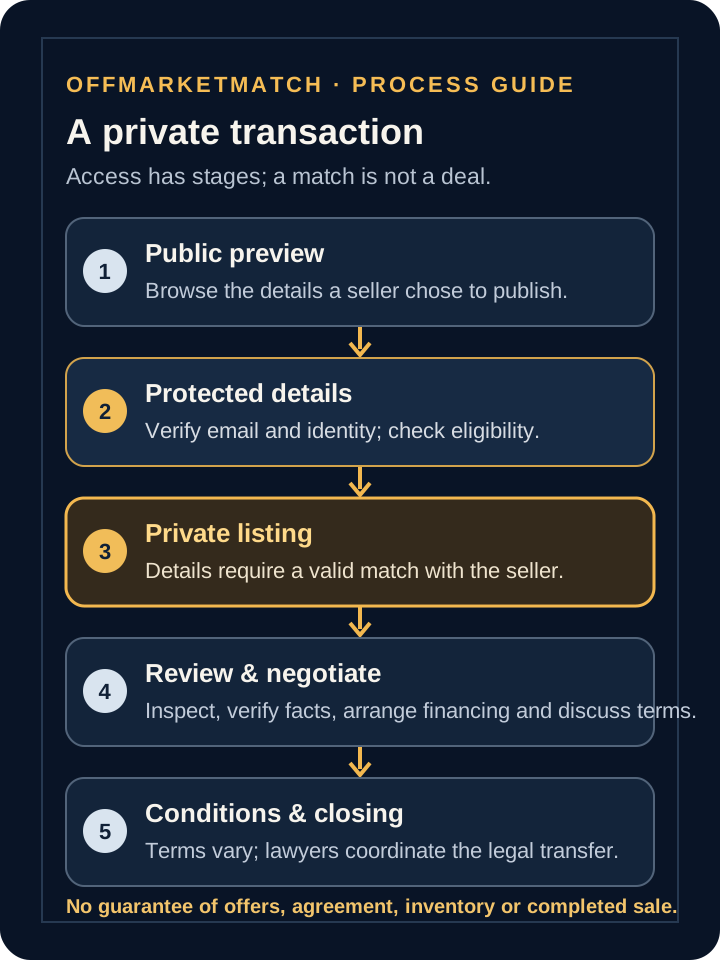
The newest and fastest-growing channel: private real estate platforms that connect buyers and sellers outside of MLS. OffMarketMatch allows investors to set a Buy Box — a defined set of criteria (geography, property type, price range, cap rate targets) — and receive automated notifications when matching properties are listed by private sellers.
This flips the traditional model: instead of the investor hunting for deals, the platform delivers curated matches. For investors who know exactly what they're looking for, this is dramatically more efficient than traditional outreach methods.
What should my search criteria include?
Define location, property type, maximum acquisition cost and the investment use you can actually finance. Separate requirements from preferences. Include renovation capacity, tenancy constraints and your time horizon. Search Profiles can organize matching criteria, but a match is not an investment recommendation. Decide which missing facts would disqualify a deal before spending time on a promising description.
How do I compare two private investment opportunities?
Put both deals into the same worksheet using asking price, documented income, expenses, financing and planned work. Label assumptions separately from seller-provided records. For a hypothetical $2,000 monthly rent, annual gross rent is $24,000 before vacancy and costs. Gross rent is not profit. Compare realistic financing and repair scenarios rather than selecting the deal with the largest headline return.
What evidence should I request for claimed rental income?
Ask for the rent roll, leases, payment history where appropriately shared, and expense records. Check whether rents are current, proposed or based on an unoccupied unit. Confirm what you are allowed to use and disclose. A seller's projection does not prove collectible income. Have tenancy and transfer questions reviewed by someone qualified in the property's jurisdiction.
How do I avoid treating an introduction as a finished deal?
Keep sourcing separate from underwriting and legal review. Finding a seller does not establish clean title, permitted use, financing eligibility or an acceptable contract. Set investigation milestones and spending limits. If the seller cannot provide basic evidence, pause. Direct access is useful because you can ask specific questions; it is not a reason to skip independent due diligence.
Primary sources and further checks
These official references cover transaction preparation and the specific topics noted below. They are not evidence of off-market sales volume, a guaranteed saving or future property prices. Check current rules and obtain advice for your own transaction.
- Financial Consumer Agency of Canada: Buying a home
Housing costs, affordability and mortgage preparation.
- CMHC: Homebuying Step by Step
Planning, evaluating a home, making an offer and closing preparation.
Key Takeaways
- 1.The best investment deals are almost always off-market — bought without MLS competition from motivated sellers
- 2.Direct mail, agent networks, estate listings, distressed properties, and private platforms are the five main channels
- 3.Off-market investing requires being known as a credible, fast-moving buyer — reputation matters enormously
- 4.Private platforms are the fastest-growing channel, allowing investors to set specific criteria and receive matched opportunities
- 5.The best off-market deals come from solving a seller's problem — speed, privacy, complexity — not just from offering lower prices
Do This Week
Define your Buy Box: write down the exact criteria for your ideal investment property (city, property type, price range, minimum suite potential or cap rate). This clarity is what makes you effective when off-market opportunities appear.
Get Started on OffMarketMatchRelated Academy Articles
How to Buy Property Before It Hits MLS in Canada
Off-Market Multifamily Investing in Canada
How Private Real Estate Transactions Work in Canada
Off-Market Real Estate in Ontario: A Complete Guide for Buyers and Sellers
Off-Market Real Estate in British Columbia: Buyers, Sellers & Investors
Ready to Put This Into Practice?
Join OffMarketMatch and access Canada's private real estate market — verified buyers, private sellers, no agent required.