Why More Canadians Are Selling Privately — and What It Means for the Market
Canadian homeowners can consider private selling when controlled exposure, direct conversations and their own marketing arrangements fit the sale. Those reasons explain the route, not how many owners use it nationally. Compare the likely buyer audience, total costs and work involved; a trend claim is not a decision rule for your property.
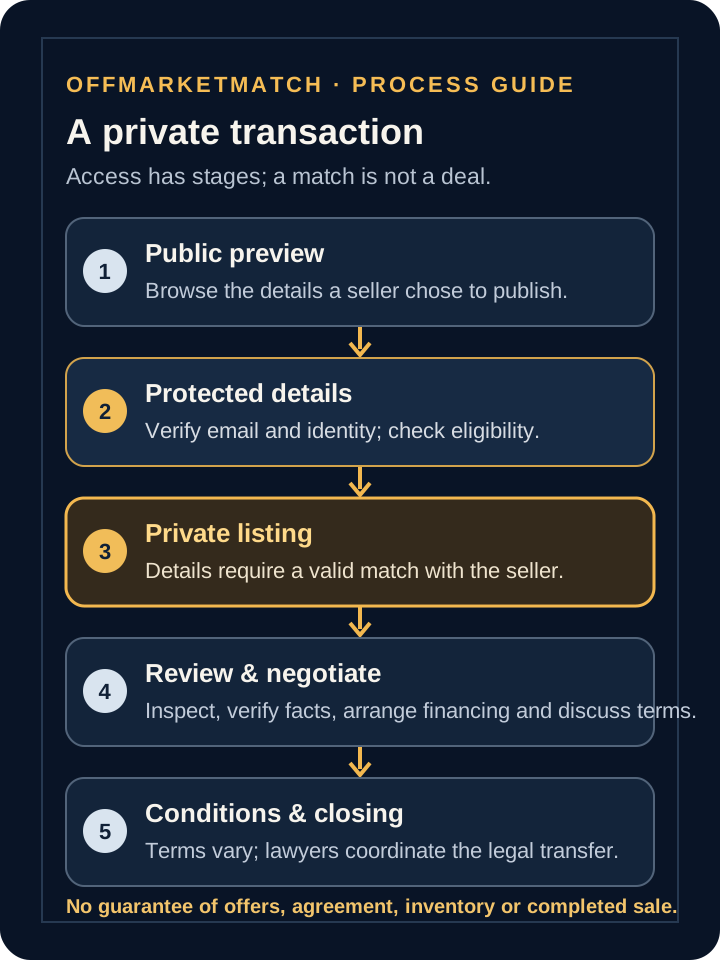
The Numbers Behind the Shift
Industry data is imprecise on private sale volumes because, by definition, they don't appear in MLS statistics. But surveys of Canadian homeowners consistently show 15–25% expressing intent to sell privately on their next transaction, up significantly from a decade ago. In certain market segments — luxury, investment properties, estate sales — the private channel already accounts for a majority of transactions.
The gap between stated intent and actual private sales reflects the historical lack of infrastructure for private transactions. As platforms like OffMarketMatch provide that infrastructure, the gap is closing.
Driver 1: Commission Costs at Record Highs in Dollar Terms
Canadian home prices have approximately doubled in most major markets since 2015. Commissions have remained at 4–5% — meaning the dollar cost of commission has doubled alongside home prices, while the actual work of transacting a home has become easier (digital signatures, automated systems, online data). The value equation has tilted decisively against the traditional model.
Driver 2: Digital Native Sellers
The cohort of sellers who are most comfortable managing complex transactions digitally — millennials and older Gen Z — is now entering the prime selling demographic. These are people who research mortgages online, manage investments through apps, complete legal documents with e-signatures, and default to digital tools for complex processes. For this cohort, the traditional model of hiring an agent to manage information on your behalf is culturally foreign.
Driver 3: The Privacy Premium
Social media and digital footprints have made Canadians more conscious of their privacy. The idea of a property listing appearing in news feeds, being shared by acquaintances, and broadcasting your home's interior photos and asking price to the internet is increasingly uncomfortable for sellers who value discretion. Private channels address this directly.
What It Means for the Industry
The real estate industry is not disappearing — but it's evolving. Agents who provide genuine value (neighbourhood expertise, complex negotiation management, luxury buyer networks, commercial real estate specialization) will continue to earn their commissions. Agents whose value proposition was primarily information gatekeeping — controlling access to sold prices, MLS listings, and buyer connections — will find their role reduced as that information becomes universally available.
For consumers, this is entirely positive: more options, more price competition, and access to professional services at the level they actually need rather than as a mandatory bundled package.
The Infrastructure Gap — Being Filled Now
The reason private sales haven't grown faster isn't lack of seller interest — it's lack of infrastructure. Private sellers needed a way to reach verified buyers; private buyers needed a curated feed of genuine seller opportunities; both sides needed privacy protection, documentation support, and trust signals.
OffMarketMatch is that infrastructure — a platform that doesn't displace the real estate market but rather organizes the portion of it that was already happening privately, without structure or protection for either side.
Does interest in private selling prove it fits my home?
No. A broader interest in privacy or direct dealing does not establish demand for a particular property. Evaluate your likely buyers, asking price, deadline and available time. Ask prospective service providers what they actually distribute and what results they do not guarantee. A channel's popularity is less useful than a clear explanation of how your own listing will reach qualified prospects.
How should I compare service fees with commission quotes?
Use written quotes and include the services attached to each one. A hypothetical 3% fee on a $700,000 sale equals $21,000 before tax. That is only an illustration, not a standard commission or a promised saving. The accepted sale price and other costs still matter. Ask about separate representation payments and contractual obligations before calculating expected net proceeds.
Which work remains with the seller?
Plan for accurate property information, inquiries, viewings, document sharing and decisions about offers. A platform can support parts of that work without taking responsibility for every task. Decide which work you will do yourself and which professionals you need. Confirm scope in writing. Choosing a fixed fee does not mean the transaction has no administrative work or additional closing costs.
How can I try the route without relying on a trend?
Set a specific evaluation period and a list of measurable questions. Are suitable buyers asking for details? Is the information sufficient? Does the asking price match the evidence?
Review those answers before changing your plan. Keep a fallback route and obtain advice about any existing listing agreement. Your decision should rest on the property's response and your obligations, not on a national headline.
Primary sources and further checks
These official references cover transaction preparation and the specific topics noted below. They are not evidence of off-market sales volume, a guaranteed saving or future property prices. Check current rules and obtain advice for your own transaction.
- Financial Consumer Agency of Canada: Buying a home
Housing costs, affordability and mortgage preparation.
- CMHC: Homebuying Step by Step
Planning, evaluating a home, making an offer and closing preparation.
Key Takeaways
- 1.Private home sales are growing as a structural share of the Canadian real estate market
- 2.Commission costs have doubled in dollar terms while actual transaction complexity has decreased — tilting the value equation
- 3.Digital-native sellers are more comfortable managing private transactions and less dependent on agent information gatekeeping
- 4.The infrastructure gap (matching, verification, documentation) is now being filled by private platforms
- 5.The industry is evolving rather than disappearing — agents providing genuine specialized value will remain relevant
Do This Week
Ask three people you know — homeowners, investors, or people who've recently transacted — what their experience with the traditional real estate model was. You'll likely hear patterns that tell you exactly what the private market is responding to.
Get Started on OffMarketMatchRelated Academy Articles
Off-Market vs. MLS: Which Is Right for Your Real Estate Transaction?
Why More Canadian Homeowners Are Selling Privately
The Hidden Real Estate Market Nobody Talks About
Are Off-Market Real Estate Deals Legal in Canada?
The Future of Private Real Estate Transactions in Canada
Ready to Put This Into Practice?
Join OffMarketMatch and access Canada's private real estate market — verified buyers, private sellers, no agent required.