The Hidden Real Estate Market Nobody Talks About
The hidden real estate market refers to properties discussed or marketed through private channels rather than public MLS searches. A conversation may be only an unconfirmed lead, not an available listing. Buyers should distinguish active opportunities from speculation, verify seller authority and assess the property before spending money or negotiating.
How Big Is the Private Market?
The honest answer is: we don't know precisely. By definition, private transactions don't appear in MLS statistics. But real estate lawyers, institutional investors, and market researchers consistently estimate that 20–30% of high-value residential transactions and the majority of commercial and investment property transactions in Canada happen outside of public listing channels.
In certain segments — luxury homes above $3M, income properties with existing tenants, estate settlements, pre-construction assignments, and development land — the private market is the primary market.
Who Participates in the Private Market?
Historically, the private market was accessible primarily to those with existing networks: developers who knew property owners, investors with agent relationships, wealthy families connected to estate lawyers. The barrier was information and introduction — if you didn't know the right people, you didn't know the deals existed.
Private listing platforms give eligible buyers another way to review opportunities outside their existing networks. Buyers still need clear criteria and independent checks; platform access does not guarantee available inventory.
Why the Private Market Exists
The private market exists because MLS — for all its power — doesn't serve every transaction well. Sellers with privacy requirements, unique properties, tenant relationships to protect, or estate complexity don't fit neatly into the MLS model. Buyers who need access before competition exists, who are looking for specific criteria that aren't well-represented in public inventory, or who want to negotiate without artificial offer-night pressure find private channels more productive.
The private market isn't a workaround — it's a natural response to the limitations of a one-size-fits-all public listing system.
The Role of Discretion
Discretion is the currency of the private market. Sellers share sensitive property information — income figures, maintenance history, personal context — only with buyers who have been verified and have signed appropriate non-disclosure agreements. Buyers who earn a reputation as professional, trustworthy counterparties get early access to opportunities. Those who share confidential information or waste sellers' time get excluded.
Discretion can help sellers control who receives property information. Buyers and sellers should still agree on sharing rules, limit sensitive disclosures and obtain advice about confidentiality obligations; a private network is not a guarantee of trust.
The OffMarketMatch Infrastructure
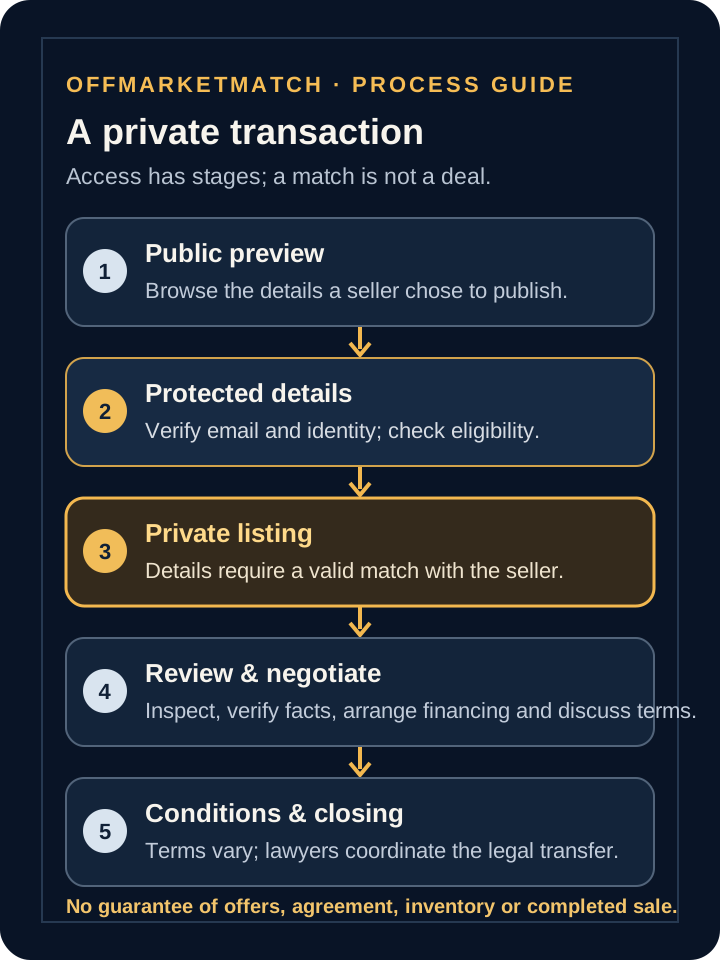
OffMarketMatch was built specifically to organize this market — to give it structure, protection, and efficiency without replacing the fundamentally private nature of the transactions. Buyers are identity-verified before accessing seller information. Sellers control who sees their property and when. NCNDAs are automatically generated and tracked. AI matching connects the right buyers with the right properties.
The goal isn't to make private real estate public — it's to make private real estate accessible to anyone who qualifies, not just those with the right connections.
How to Access the Private Market
Accessing the private market as a buyer requires: verified identity, clear criteria (your Buy Box), demonstrated financial qualification, and a reputation as a serious, professional counterparty. As a seller, it requires: a private platform with genuine buyer access, appropriate privacy protections for your property information, and confidence that the buyers who see your property are qualified and motivated.
Both of these requirements are met through OffMarketMatch — the infrastructure layer that Canada's private real estate market has been missing.
What makes an opportunity genuinely available?
A conversation or private introduction is not enough. Ask whether the owner intends to sell, who has authority to negotiate, and what information supports the property's identity and condition. Confirm access to the documents needed for evaluation. A privately discussed property can be unavailable, inaccurately described or subject to commitments elsewhere. Treat discovery as the start of verification.
How do I search without assuming there is hidden inventory?
Choose a location, budget and property type, then use appropriate channels and specific inquiries. Record whether a lead is an active listing, an introduction or an unconfirmed possibility. Do not count every conversation as a deal. Search Profiles can organize preferences, but they cannot guarantee that suitable sellers exist. Review the evidence behind each opportunity before advancing it in your pipeline.
What should I do with a claimed exclusive opportunity?
Ask what exclusivity means and which document establishes it. Clarify whether other buyers are being approached and whether the seller has a representation agreement. Do not pay merely for a label such as exclusive or hidden. Your legal adviser can review any proposed commitment. The valuable information is who can sell, on what terms, and with what evidence.
How do I compare a private lead with a public listing?
Use the same due diligence questions and total-cost calculation for both. Check financing, title, condition, tenancy and permitted use as appropriate. A hypothetical $20,000 repair requirement belongs in the budget regardless of how you found the property. Private access may change the conversation, but it does not remove costs or establish a better investment. Keep assumptions separate from verified records.
Primary sources and further checks
These official references cover transaction preparation and the specific topics noted below. They are not evidence of off-market sales volume, a guaranteed saving or future property prices. Check current rules and obtain advice for your own transaction.
- Financial Consumer Agency of Canada: Buying a home
Housing costs, affordability and mortgage preparation.
- CMHC: Homebuying Step by Step
Planning, evaluating a home, making an offer and closing preparation.
Key Takeaways
- 1.An estimated 20–30% of high-value Canadian real estate transactions happen outside MLS in private channels
- 2.The private market has historically been accessible only to insiders — technology is changing this
- 3.Discretion, trust, and professional reputation are the currencies of the private market
- 4.Private transactions serve sellers with privacy needs, unique properties, and complex situations that MLS handles poorly
- 5.OffMarketMatch provides the infrastructure to make private real estate accessible without making it public
Do This Week
The next time you hear about a property sale in your network — a neighbour selling, a family member transacting — ask how they found their buyer or seller. You may discover the private market is closer to your own life than you realize.
Get Started on OffMarketMatchRelated Academy Articles
Off-Market vs. MLS: Which Is Right for Your Real Estate Transaction?
How Real Estate Investors Find Off-Market Deals in Canada
Why More Canadians Are Selling Privately — and What It Means for the Market
Are Off-Market Real Estate Deals Legal in Canada?
The Future of Private Real Estate Transactions in Canada
Ready to Put This Into Practice?
Join OffMarketMatch and access Canada's private real estate market — verified buyers, private sellers, no agent required.