Off-Market Multifamily Investing in Canada
Off-market multifamily investing means sourcing rental buildings outside public MLS marketing and assessing the actual income, expenses and property risks. Request rent rolls, leases and operating records before relying on an advertised return. Check financing, title, condition and tenancy obligations independently; private access does not make a building a sound investment.
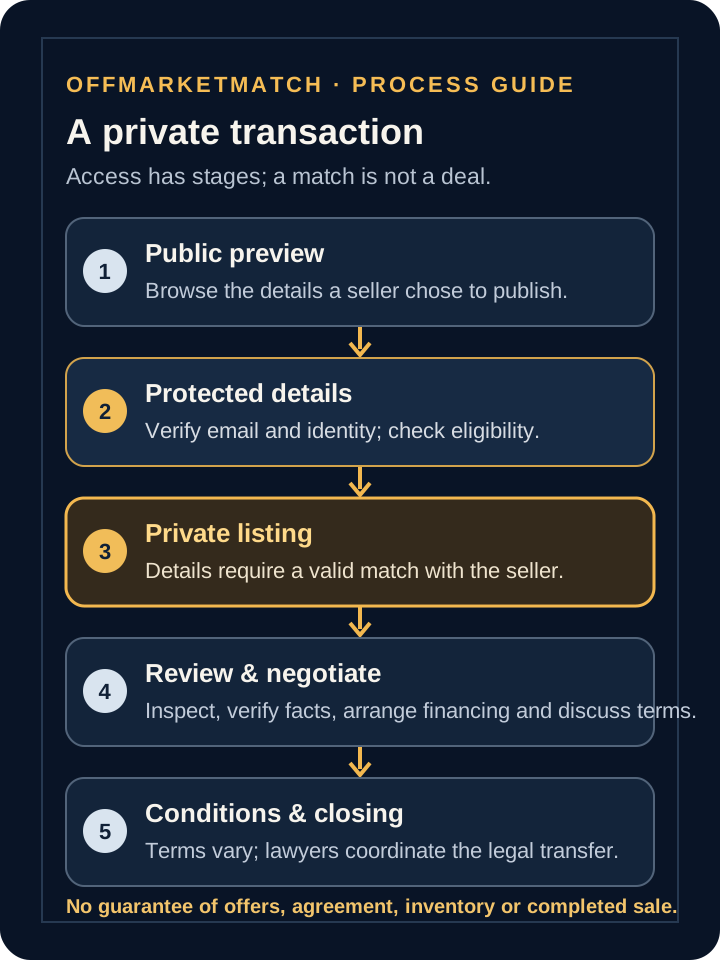
Why Multifamily Sellers Prefer Private Transactions
A revenue property has tenants. Those tenants have privacy rights, lease agreements, and — critically — knowledge of the building's condition and history. When a seller lists a revenue property on MLS, they're effectively inviting scrutiny of their rental income, tenant relationships, maintenance history, and financial performance.
Most experienced landlords prefer to avoid this. A private sale lets them share financial information with qualified, vetted buyers only — and only after appropriate NDAs are in place. This is why the majority of income properties in Canada change hands without ever appearing on public portals.
The Canadian Multifamily Market: By Province
The multifamily investment landscape varies significantly by province. Quebec's plex market — duplexes through six-plexes — is uniquely active and frequently traded off-market between investors who understand this specialized asset class. Ontario's multiplex neighbourhoods in Hamilton, Ottawa, and older Toronto are popular for conversion and income optimization.
Alberta has no rent control, making it the most landlord-friendly province for investment — Calgary and Edmonton duplexes and basement-suite homes generate real cash flow. BC's strata market has specific income property rules, but duplex and small apartment buildings near universities perform strongly.
How to Analyze a Multifamily Off-Market Deal
When you receive an off-market multifamily opportunity, you need to evaluate it quickly and confidently. Key metrics: Gross Rent Multiplier (GRM) = Purchase Price / Annual Gross Rents. Cap Rate = Net Operating Income / Purchase Price. Cash-on-Cash Return = Annual Cash Flow / Total Cash Invested.
For a quick initial screen: take the annual gross rents, multiply by 50% to estimate operating expenses (the 50% rule), subtract mortgage service, and see if you have positive cash flow. If the numbers don't work at first pass, they rarely improve on deeper analysis.
Due Diligence for Off-Market Multifamily
Off-market doesn't mean skipping due diligence — it means doing it efficiently. Request: T1 and T2 forms (income and expense declarations) or equivalent rental income records for the past two years, current lease agreements for all units, municipal property tax bills, any property management agreements, and the property's maintenance and repair history.
Have a building inspector who specializes in revenue properties conduct the inspection — they know what to look for in income properties (shared mechanical systems, fire code compliance, electrical panels). Budget for any remediation in your offer price.
Making the Offer on an Off-Market Multifamily
Off-market offers are typically made directly to the seller with your lawyer involved from the beginning. Include conditions for: financing approval, income verification (confirming actual rents match claimed rents), property inspection, and lawyer review.
Negotiate conditions that give you time to complete proper due diligence without rushing. The seller chose private in part because they want a smoother, less adversarial process — match that energy with a professional, organized offer package.
Building Your Off-Market Multifamily Pipeline
The best multifamily investors build a sustainable pipeline of opportunities rather than chasing individual deals. This means: a Buy Box registered on OffMarketMatch that automatically matches you with income properties meeting your criteria; relationships with lawyers who handle estate settlements (estates frequently include income properties); connections with property managers who know which landlords are considering exiting; and a reputation as a fast, professional closer who doesn't create problems.
Which income numbers belong in underwriting?
Separate current collected rent from market-rent projections and vacant-unit assumptions. Review leases, the rent roll and appropriately shared payment records. Identify arrears, incentives and services included in rent. For a hypothetical building collecting $8,000 monthly, annual gross rent is $96,000 before expenses. That number alone does not establish net operating income, financing capacity or the value of the property.
How do I check the expense side?
Request support for insurance, taxes, utilities, maintenance and management costs. Distinguish regular operating expenses from deferred repairs and major replacements. Ask which costs are paid by tenants and whether that arrangement is documented. A small apparent expense change can materially alter projected cash flow. Use a reserve for uncertain work and show how the result changes if your assumptions prove optimistic.
What must I check about the units themselves?
Confirm the permitted use, unit configuration and any relevant approvals with the appropriate records and qualified advisers. A unit advertised as rented is not automatically a lawfully established dwelling. Review inspection findings and major systems separately from rental performance. Zoning, fire safety, tenancy rules and insurance eligibility can each affect whether the proposed investment can operate as you expect.
What if I plan to increase rents after purchase?
Do not treat a desired rent increase as income already available. Existing leases and local rules may limit changes or require specific procedures. Ask for jurisdiction-specific advice before building the purchase around turnover or eviction assumptions. Underwrite a scenario using current documented income as well as your proposed plan. If the deal only works under an uncertain legal outcome, make that risk explicit.
Primary sources and further checks
These official references cover transaction preparation and the specific topics noted below. They are not evidence of off-market sales volume, a guaranteed saving or future property prices. Check current rules and obtain advice for your own transaction.
- Financial Consumer Agency of Canada: Buying a home
Housing costs, affordability and mortgage preparation.
- CMHC: Homebuying Step by Step
Planning, evaluating a home, making an offer and closing preparation.
Key Takeaways
- 1.The majority of income properties in Canada trade off-market — sellers prefer the privacy and control of private channels
- 2.Quebec's plex market and Ontario's multiplex neighbourhoods are Canada's most active off-market multifamily segments
- 3.Alberta's no-rent-control environment makes it the most investor-friendly province for cash-flow-focused multifamily buying
- 4.Due diligence for off-market multifamily requires income verification, lease review, and specialized property inspection
- 5.Building a sustainable pipeline — Buy Box matching, lawyer relationships, property manager networks — beats chasing individual deals
Do This Week
Calculate the cap rate and cash-on-cash return for a multifamily property you find interesting. If you don't have an example, use this assumption: a $600,000 duplex with $3,000/month gross rent. Work through the numbers — understanding the math before you need it is what lets you move fast when a real opportunity appears.
Get Started on OffMarketMatchRelated Academy Articles
How Real Estate Investors Find Off-Market Deals in Canada
How to Buy Property Before It Hits MLS in Canada
How Private Real Estate Transactions Work in Canada
Off-Market Real Estate in Ontario: A Complete Guide for Buyers and Sellers
Off-Market Real Estate in British Columbia: Buyers, Sellers & Investors
Ready to Put This Into Practice?
Join OffMarketMatch and access Canada's private real estate market — verified buyers, private sellers, no agent required.